Courtesy of Kittie Wilson
Common Loon Plumage and Body Structure
Male and female loons have identical plumage, which makes them nearly impossible to tell apart by sight alone. Although males are generally about 25% larger than females, this size difference is difficult to determine visually. In New Hampshire, adult loons weigh from 7 to 15 pounds and measure roughly 3 feet from bill tip to outreached feet. The skeleton and muscular systems of a loon are designed for swimming and diving. A loon’s legs are placed far back on its body, allowing for excellent swimming in water but making them ungainly on land. Loons have bones that are more dense than bones of most other flying birds. These heavy bones make loons less buoyant, which helps them to dive. The loon’s large webbed feet provide propulsion and steering underwater.

Breeding Plumage
In its summer breeding plumage, the common loon has a black-and-white checkered back, iridescent black head and neck, black bill, red eyes, a prominent white “necklace” marking around the neck, and a much smaller white “chinstrap” marking at the throat. The white feathers of the belly and wing linings are present year-round.

Molting Adult
At the end of the breeding season, adult loons begin their molt. During this time, they transition from their striking black-and-white breeding plumage into their gray-and-white winter plumage. This transition typically begins with the feathers surrounding the bill. In New Hampshire, molting usually begins in late September or early October.

Adult Winter Plumage
In its winter plumage, the Common Loon is dark gray above with a white breast, belly, and wing linings. The bill is light gray, and the eyes dull to a deep reddish-brown.
Juvenile Plumage
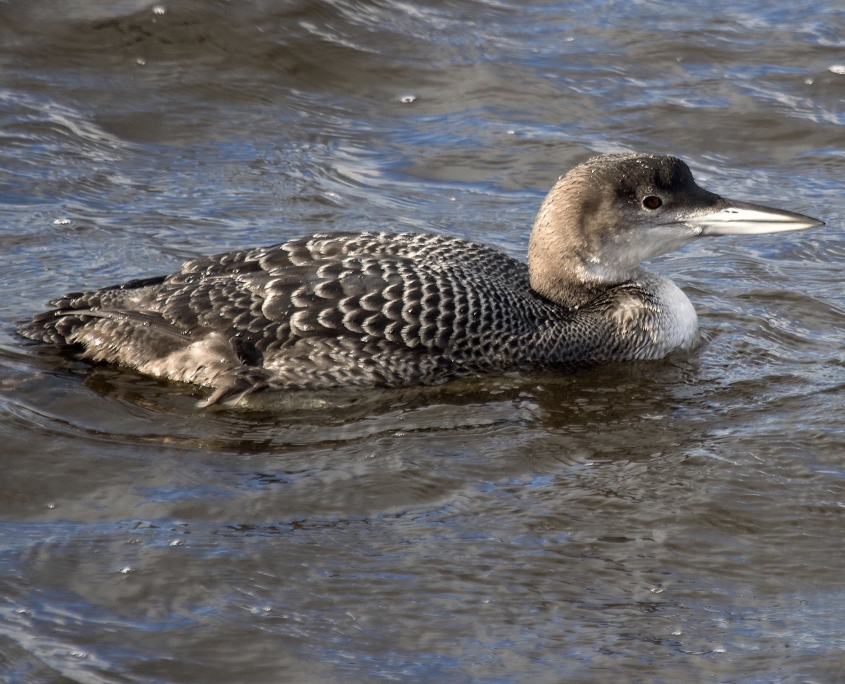
Juvenile loons are similar to wintering adult loons in appearance. The feathers on their backs and heads are grayish-brown, and their undersides are white. Juvenile loons can be told apart from wintering adults by the distinct whitish-gray tips of their feathers, which create a scalloped pattern.

